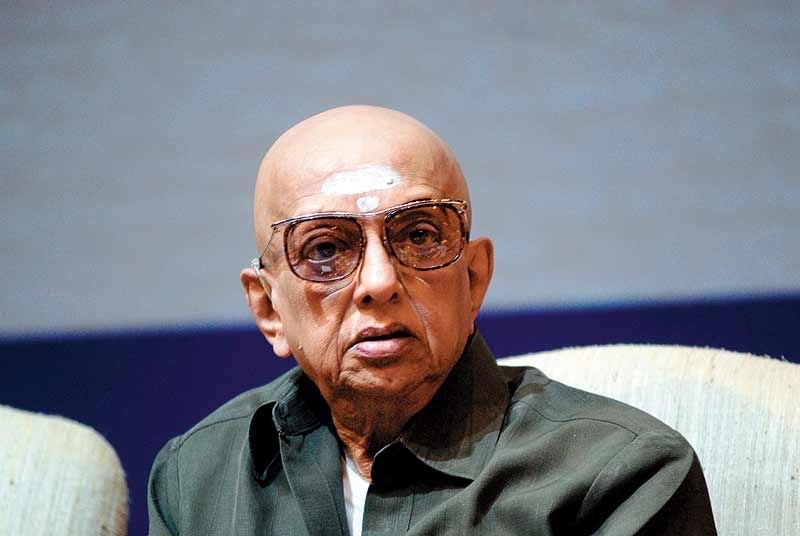
A tribute to Cho Ramaswamy , the man who shaped minds he never met.
It is remarkable how some figures enter our lives quietly, long before we possess the vocabulary to recognize their brilliance. They slip in without ceremony , between the rustle of pages, the wit of a cartoon, the laughter of a grandfather leaning over a magazine. For me, Cho Ramaswamy walked into my life exactly this way. I was seven or eight, blissfully unaware of politics, yet unfailingly drawn to one weekly ritual in our home: the arrival of Tughlaq (Tamil) magazine. My grandfather would bring home that fresh, crisp copy every week, and while adults turned to the editorials, I rushed straight to the cover. Those bold, mischievous cartoons were my gateway , the earliest teachers of humour, audacity, satire, and the first quiet nudge towards independent thought.

As I grew older, the discovery deepened. What began with cartoons evolved into devouring every word Cho ever wrote. Washingtonil Nallathambi taught me that satire could be both cultural anthropology and comedy. Enge Brahmanan, made philosophy feel like a conversation between familiar neighbours , affectionate in one moment, merciless in the next. Hindu Maha Samudram opened up the vast, tide-like sweep of our civilisation : dharma, memory, metaphysics, history, all rendered with a clarity only Cho could muster, making the profound feel accessible and the ancient startlingly alive. And then came his incomparable Mahabharatam Pesugirathu. I still remember tugging at my mother’s soft, well-thumbed copies and losing entire afternoons to them. Cho didn’t merely retell the Mahabharata; he interrogated it, argued with it, adorned it with cross-references from multiple versions, and transformed it into a living contemplation of ethics, power, and human frailty. For many, the Mahabharata is a grand story. For Cho, it was a diagnostic instrument, a mirror held up to modern India.

A few personal favourites , proof that good ideas don’t age, they deepen.
But to understand Cho, you must understand Tughlaq, the magazine he launched in January 1970 with two donkeys on the cover , a cheeky proclamation that a new political circus had arrived. Many in Tamil Nadu sniggered that it would be “a donkey today, an ant tomorrow,” going after a famous Tamil idiom (கழுதை தேய்ந்து கட்டெறும்பு ஆனது) but Tughlaq didn’t shrink. It grew , jagged, fearless, irreverent, indispensable.

Vintage first-edition cover page, unmistakably Cho.
In a landscape dominated by Dravidian politics, where most publications kept their heads low and their voices lower, Tughlaq stood tall as the single unblinking eye of dissent. When a procession in Salem insulted Hindu deities and those in power denied it, Tughlaq published photographic proof. The government responded by seizing the entire print run. But a few bundles escaped , whispered about, hidden, passed from hand to hand like contraband literature in a world without social media. And Cho, with his trademark mischief, responded with a cover featuring a the then-leader seated at a desk labelled:
“Tughlaq Circulation Manager.”
That single cartoon told the entire story.
And then came the Emergency. I didn’t learn about this chapter from textbooks; I learned it through my father’s recollections, through archived issues preserved like relics, and through Cho’s talks that outlived the era. Only then did I understand the magnitude of what Tughlaq dared to do. When censorship tightened like a noose and truth was edited out of existence, Tughlaq stood alone , the only Tamil publication to oppose the Emergency openly. Cho didn’t merely push back; he outwitted the system at every turn, finding ways to slip truth past the censors with a kind of intellectual agility that has become the stuff of quiet legend. He wasn’t just resisting authoritarianism , he was thinking circles around it.
His theatre carried the same audacity. Muhammad Bin Thuglak, his masterpiece among 23 plays, was slapstick on the surface and surgical underneath , a masterclass in political hypocrisy. Cho never targeted ordinary people; his satire always travelled upwards, towards power. And though he advised leaders across the spectrum, he never belonged to them. His allegiance lay with truth , inconvenient, graceless, undiluted truth. He admired principled figures like Jagjivan Ram, Morarji Desai, and Kamaraj, yet never hesitated to criticise them when clarity demanded it. He never subscribed to Tamil Nadu’s cinema-to-politics grammar, and he slipped past every ideological grid, Congress conventions, Dravidian theatrics, and the Left–Right binaries . He belonged to the smallest of categories , the independently thinking Indian, a species so rare it might as well be considered endangered.

His personal bonds were legendary, especially his long, complex, deeply affectionate friendship with former Tamil Nadu Chief Minister J Jayalalithaa. Their careers began in the same cultural moment, and when Cho was hospitalised toward the end, she visited him, saying gently, “Anna, you will get well soon.” Fate, strangely poetic, reunited them even in departure , he passed barely a day and a half after she did, in the same hospital.
And then came the moment I still narrate to my friends from the north of Vindhyas, many of whom grew up without ever encountering Cho’s razor-edged wit or his almost prophetic political intuition. To appreciate that evening in 2008 is to recall its backdrop: just a year earlier, during the Gujarat elections, a senior national leader from the then ruling government had famously branded Narendra Modi ji a “Maut ka Saudagar” , a “Merchant of Death” , a phrase intended as an indictment, designed to wound. Cho, in the flamboyant irreverence only he possessed, lifted that phrase out of its bitterness and refashioned it with theatrical brilliance. When Narendra Modi ji arrived at the Tughlaq Annual Day in 2008 as the newly re-elected Chief Minister of Gujarat, the hall already pulsing with anticipation, Cho stepped to the microphone, paused with impeccable timing, and delivered an introduction that quietly entered political legend:
“I now invite… the Merchant of Death —
the Merchant of Death to Terrorism,
the Merchant of Death to Corruption,
the Merchant of Death to Nepotism…”
The video that never gets old !!
It was not humour for humour’s sake; it was the alchemy of satire , an attempted slur transformed into a salute. As the hall erupted, it became clear that Cho had read PM Modi long before most of India did. He recognised the discipline, the administrative steel, the conviction that would eventually reshape the nation’s political landscape. And when I narrate these moment to friends from the Northern part of the country, I say only this: Cho sensed it years before it entered public imagination , that was the sharpness of his foresight.
This day, nine years back, the void he left felt immeasurable. Not because Tamil Nadu lost a cultural force. Not because India lost a satirist. But because we lost a conscience , one that questioned without malice, laughed without cynicism, and spoke truth without theatricality. He shaped a generation of minds quietly, long before they realised they were being shaped. Mine is one among them , a child who came for the cartoon, stayed for the humour, and grew into the questions he taught me to ask.
And as I pen this from thousands of miles away from home, nine years since his passing , from far away on a quiet winter afternoon watching a reluctant Canadian winter gather itself outside my window, my thoughts drift back to those evenings when the crackle of a new Tughlaq magazine felt like the most important sound in the house. Distance does funny things: it sharpens nostalgia, and it amplifies gratitude. I am no intellectual heavyweight, no grand commentator. Whatever little clarity I have about dharma, governance, public life, and plain old common sense, I owe to the seeds he planted , through satire that stung, humour that healed, and writing that refused to dilute itself for comfort. If I stand today with an unapologetic affection for my civilisational roots, a bias for honesty over theatrics, and a mild but incurable interest in politics… well, Cho did that.
Many public figures appear, dazzle briefly, and vanish like festival fireworks. But a mind like Cho’s does not vanish. It remains , steady, sharp, unyielding , a permanent landmark in India’s political and cultural landscape.
If these words read like a fan-girl’s tribute, that is because they are.
If they read like gratitude, that is because he deserves every bit of it.
His imprint will endure , not merely on pages or stages, but on minds he sharpened, questions he planted, and convictions he gave courage to articulate. It is a legacy India will feel for generations.
📖 Washingtonil Nallathambi
📖 Enge Brahmanan?
https://www.amazon.in/s?k=Enge+Brahmanan+Cho+Ramaswamy
📖 Mahabharatam Pesugirathu
https://www.amazon.in/s?k=Mahabharatam+Pesugirathu+Cho
📖 Hindu Maha Samudram
https://www.amazon.in/s?k=Hindu+Maha+Samudram+Cho
📖 Tughlaq Letters / Tughlaq Q&A Compilations
https://www.amazon.in/s?k=Tughlaq+Letters+Cho
📖 Muhammad Bin Thuglak (Play)
https://www.amazon.in/s?k=Muhammad+Bin+Thuglak+Cho




Leave a Reply